Iron(III) oxide Fe₂O₃
The red oxide: two ways to make it
1. Iron oxides
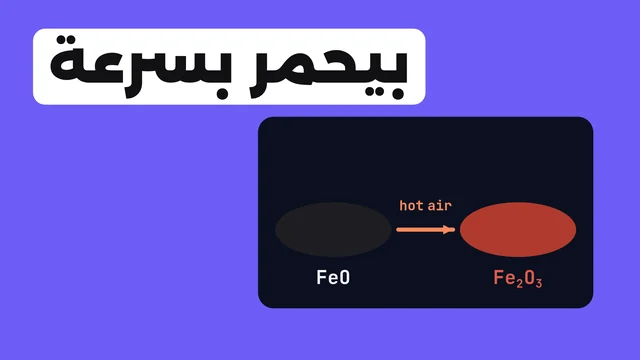
2. What is left after heating?
Heat iron (II) sulphate, FeSO4, strongly. Two gases leave, and a red solid stays behind.
Pick the right answer
Predict: what is the red solid?
- A. FeO
- B. Fe2O3
- C. Iron metal
- D. FeS
Explanation
The red solid is Fe2O3: 2FeSO4 → Fe2O3 + SO2 + SO3. Iron (II) is oxidized to iron (III), and the sulphur leaves in the two gases.
3. Preparation 1: from an iron(III) salt
On adding an alkali to an aqueous solution of iron (III) salts, the (reddish brown) iron (III) hydroxide precipitates.
gatheredFeCl3(aq) + 3NH4OH(aq) →\\ Fe(OH)3(s) v + 3NH4Cl(aq)gathered
Partners swap: a double displacement. Fe(OH)3 does not dissolve, so it precipitates.
- FeCl3 solution → Fe(OH)3, reddish brown (+ alkali)
- Fe(OH)3, reddish brown → Fe2O3 (above 200 °C)
4. Heat the hydroxide
Heating iron (III) hydroxide above 200 °C converts it to iron (III) oxide.
Balance the equation
Balance the equation.
Fe(OH)3 →[above 200\,^C] Fe2O3 + H2O
Balanced equation
2Fe(OH)3 →[above 200\,^C] Fe2O3 + 3H2O
Explanation
Fe2O3 needs 2 Fe: 2 Fe(OH)3. Their 6 H leave as 3 H2O.
Need a hint?
- How many Fe atoms does Fe2O3 need?
- Count the H atoms in that many Fe(OH)3. Each H2O takes two.
5. Preparation 2: heating iron(II) sulphate
2FeSO4(s) →[Δ] Fe2O3(s) + SO2(g) + SO3(g)
Two gases leave: sulphur dioxide and sulphur trioxide.
Why two gases?
- 2 S on the left: one leaves in SO₂, one in SO₃.
- Iron is oxidized: +2 → +3.
- To pay for that, one S is reduced: +6 → +4 in SO₂. The other S stays +6 in SO₃.
6. In nature and in paints
- This oxide is present in nature in the form of hematite.
- It is insoluble in water.
- It is used in red pigments in paints.
| Property | Iron (III) oxide |
|---|---|
| Found in nature as | hematite |
| In water | insoluble |
| Used in | red pigments in paints |
Hematite is the red iron ore you met in the extraction unit.
7. With hot concentrated acids
gatheredFe2O3(s) + 3H2SO4(aq) →[Δ][conc.]\\ Fe2(SO4)3(aq) + 3H2O(v)gathered
It reacts with hot conc. mineral acids to form iron (III) salts and water.
Iron stays +3, so the salt is an iron (III) salt. No gas forms.
8. Your turn
Balance the equation
Balance Fe2O3 with hot concentrated hydrochloric acid.
Fe2O3 + HCl →[Δ][conc.] FeCl3 + H2O
Balanced equation
Fe2O3 + 6HCl →[Δ][conc.] 2FeCl3 + 3H2O
Explanation
2 Fe give 2 FeCl3: 6 Cl, so 6 HCl. 6 H make 3 H2O.
Pick the right answer
An alkali is added to iron (III) nitrate solution, Fe(NO3)3. What forms first?
- A. A reddish brown precipitate of Fe(OH)3
- B. Fe2O3 directly
- C. Hydrogen gas
- D. Nothing: only FeCl3 gives this precipitate
Explanation
A reddish brown precipitate of Fe(OH)3 forms first: an alkali gives this precipitate with an aqueous solution of iron (III) salts, and iron (III) nitrate is one of them. The oxide forms only after the hydroxide is heated above 200 °C.
True or false?
Heating iron (II) sulphate gives FeO and SO3 only.
Explanation
The statement is false: heating iron (II) sulphate gives Fe2O3, SO2 and SO3, so the red oxide is left and two gases leave.
9. Summary
- Alkali + iron (III) salt → reddish brown Fe(OH)3; above 200 °C → Fe2O3 + water.
- Heating FeSO4 → Fe2O3 + SO2 + SO3.
- Found as hematite; insoluble in water; used in red pigments in paints.
- Hot conc. acid + Fe2O3 → iron (III) salt + water.
Can you explain why heating FeSO4 gives two different sulphur gases?
Reveal
Iron is oxidized from +2 to +3. To pay for that, one S is reduced from +6 to +4 and leaves in SO2; the other S stays +6 and leaves in SO3.