Iron(II) oxide FeO
A black oxide that must be kept from hot air
1. Iron oxides
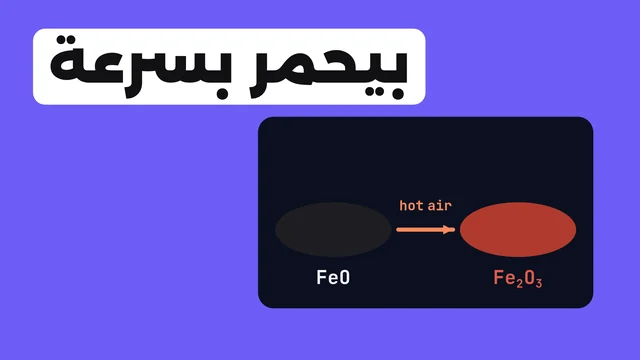
2. Keep the air out?
To make iron (II) oxide, FeO, we heat a compound until it breaks down. The twist: FeO is easily oxidized in hot air.
Pick the right answer
Predict: when we heat the compound to get FeO, should air be present?
- A. Yes, air is needed to form any oxide.
- B. No, air must be kept out.
- C. It makes no difference.
Explanation
Air must be kept out: FeO is easily oxidized in hot air to Fe2O3. That is why the book heats iron (II) oxalate in absence of air; the oxygen in FeO comes from the compound itself.
3. Preparation 1: heating iron(II) oxalate
Iron (II) oxalate
FeC2O4, an iron (II) salt. The book draws it as two COO groups joined to Fe.
gatheredFeC2O4(s) →[Δ][in absence of air]\\ FeO(s) + CO(g) + CO2(g)gathered
This is a thermal decomposition. Heating in absence of air keeps the FeO from being oxidized.
4. Preparation 2: reducing higher oxides
FeO is also made by reduction of higher oxides by hydrogen or carbon monoxide.
Higher oxides have more oxygen per iron atom: Fe2O3 and Fe3O4.
gatheredFe2O3(s) + H2(g) →[400-700\,^C]\\ 2FeO(s) + H2O(v)gathered
Why 2FeO?
- Fe2O3 holds 2 Fe atoms, so 2 FeO form.
- 2 FeO hold 2 O atoms; Fe2O3 had 3. The extra O joins H2 as H2O.
- Hydrogen removes oxygen: it is the reducing agent.
5. Your turn: from Fe₃O₄
Balance the equation
Reduce magnetic iron oxide, Fe3O4, with hydrogen at 400–700 °C. Balance the equation.
Fe3O4 + H2 →[400-700\,^C] FeO + H2O
Balanced equation
Fe3O4 + H2 →[400-700\,^C] 3FeO + H2O
Explanation
3 Fe give 3 FeO. 4 O − 3 O leaves 1 O for one H2O.
Need a hint?
- How many Fe atoms are in Fe3O4? Each FeO holds one.
- Count O: how many does FeO keep, and how many are left over?
- Each leftover O needs one H2 to make water.
6. Properties: black, and easily oxidized
- It is black powder, insoluble in water.
- It is easily oxidized in hot air:
gathered4FeO(s) + O2(g) →[Δ]\\ 2Fe2O3(s)gathered
This is why its preparation needs absence of air.
7. With dilute acids: an iron(II) salt
gatheredFeO(s) + H2SO4(aq) →[(dil.)]\\ FeSO4(aq) + H2O(l)gathered
It reacts with mineral acids forming iron (II) salts and water.
FeO is a basic oxide: acid + basic oxide → salt + water. No gas forms.
8. Your turn
Fill in the blanks
FeO + 2HCl → _____ + H2O
Explanation
Iron stays +2: iron (II) chloride, FeCl2, and water.
Pick the right answer
A student heats iron (II) oxalate in an open dish, in air. A red powder is left, not a black one. Why?
- A. The FeO formed was oxidized by hot air to Fe2O3.
- B. FeO is red, so the experiment worked.
- C. Iron (II) oxalate does not decompose on heating.
- D. Hot air reduced the FeO.
Explanation
Heating in air oxidized the FeO as it formed: 4FeO + O2 → 2Fe2O3. FeO is a black powder and Fe2O3 is red, which is why the book heats iron (II) oxalate in absence of air.
9. Summary
- Prepare FeO by heating iron (II) oxalate in absence of air.
- Or reduce Fe2O3 or Fe3O4 with hydrogen or CO at 400–700 °C.
- FeO is a black powder, insoluble in water, easily oxidized in hot air.
- FeO + dilute acid → iron (II) salt + water.
Can you explain why FeO gives an iron (II) salt, not an iron (III) salt, with a dilute acid?
Reveal
Nothing is oxidized: iron is +2 in FeO and stays +2 in the salt. FeO is a basic oxide, so acid + FeO → iron (II) salt + water, e.g. FeSO4 with dilute H2SO4.