Interstitial alloys
Small atoms in the spaces stop the layers slipping
1. Alloys and their types
2. Soft iron, hard steel
The book says pure iron is relatively soft, so it has no industrial importance. Steel is iron with a little carbon.
Pick the right answer
Predict: what does adding the small carbon atoms do to iron?
- A. It makes iron harder
- B. It makes iron softer
- C. Nothing: there is too little carbon
Explanation
Adding carbon makes iron harder. The small carbon atoms sit in the spaces of the iron lattice and prevent the movement of its layers, so steel is harder than pure iron, which is relatively soft.
3. Inside a pure metal
Crystal lattice
The regular arrangement of atoms in a solid. In a pure metal, the atoms are arranged in compact close rows.
Pure iron, like other metals, is built this way. All its atoms are the same size.
4. Hammer the pure metal
Recall the metallic bond: layers of atoms can slide over each other. Try it.
Hammer (0 = no, 1 = hit) 0
5. Small atoms in the spaces
Interstitial alloy
An alloy formed by introducing atoms of an element with a small atomic size into the spaces of the crystal lattice of a pure metal.
The small atoms prevent the movement of the metal layers. So the metal becomes harder.
True or false?
When carbon is added to iron, carbon atoms replace iron atoms.
Explanation
The statement is false. In an interstitial alloy no iron atom is replaced: the carbon atoms, with a small atomic size, enter the spaces of the iron lattice.
6. Pure iron or steel?
Choose with or without carbon, then hammer. Compare what the hammer does to each metal.
Carbon atoms added (0 = no, 1 = yes) 0
Hammer (0 = no, 1 = hit) 0
7. More than hardness
The small atoms increase the hardness. They also change other physical properties of the metal:
- small atoms enter the spaces of the lattice → hardness increases
- hardness increases → other physical properties change
- malleability
- ductility
- melting point
- electric conductivity
- magnetic properties
Book example: the alloy of iron and carbon, steel.
8. Same elements, another type
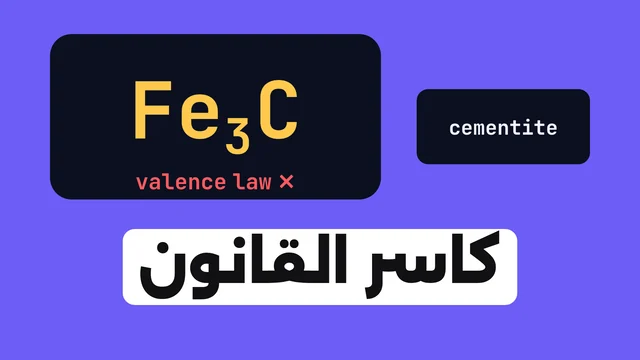
Iron and carbon can also combine chemically into cementite, Fe3C. That makes it a different type.
| Steel | Cementite | |
|---|---|---|
| Fe and C | C atoms sit in the spaces | combine chemically |
| Formula | none fixed | Fe3C |
| Type | interstitial | intermetallic |
Intermetallic alloy
An alloy whose elements combine chemically into a compound. You will study it soon.
9. Check yourself
Pick the right answer
Metal M is soft. A few atoms of element Z, much smaller than M atoms, are put into the spaces of its lattice. What happens?
- A. M gets harder: Z atoms block the layers from slipping
- B. M gets softer: Z atoms help the layers roll
- C. Z atoms take the places of some M atoms
- D. Nothing changes: the rows are the same
Explanation
M gets harder. Z atoms are much smaller than M atoms, so they enter the spaces of the lattice (an interstitial alloy) and block the layers from slipping on hammering.
True or false?
In steel, some iron atoms are replaced by carbon atoms.
Explanation
The statement is false. Steel is an interstitial alloy: the small carbon atoms sit in the spaces between the iron atoms, and no iron atom is replaced.
True or false?
Cementite, Fe3C, is an interstitial alloy, like steel.
Explanation
The statement is false. In cementite, Fe3C, iron and carbon combine chemically into a compound, so it is an intermetallic alloy; steel is the interstitial one.
Fill in the blanks
Steel is harder than pure iron because the small carbon atoms prevent the _____ of the metal layers.
Explanation
On hammering, the layers of a pure metal slip. In steel, the small carbon atoms in the spaces prevent the movement of the iron layers, so steel is harder.
10. Summary
- pure metal: a layer slips on hammering → small atoms enter the spaces
- small atoms enter the spaces → the layers cannot move
- the layers cannot move → harder metal, e.g. steel (Fe + C)
- Pure metal: atoms in compact close rows. On hammering, a layer slips over the others.
- Interstitial alloy: atoms with a small atomic size enter the spaces of the lattice.
- They block the layers: the metal gets harder, and other physical properties change.
- Steel (Fe + C) is interstitial. Cementite, Fe3C, is intermetallic.
Can you explain, with a drawing, why steel is harder than pure iron?