Oxidation state in compounds
Finding the metal's oxidation state from a formula
1. Properties of iron
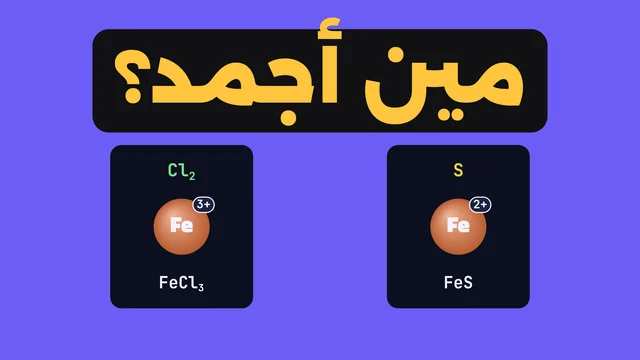
2. No charge written
Fe³⁺ shows its charge. In Fe2O3 no charge is written, yet the book calls it iron (III) oxide.
Pick the right answer
Predict: in FeO, oxygen counts as −2. What does iron count as?
- A. +2
- B. −2
- C. +1
- D. 0
Explanation
A neutral compound has a total charge of zero. With oxygen at −2, iron in FeO counts as +2, because +2 + (−2) = 0.
3. Oxidation state
Oxidation state
The charge an atom has, or seems to have, in a compound or ion. It is written with a sign, like +2 or −1.
| Particle | Oxidation state |
|---|---|
| An element on its own (Fe, H2) | 0 |
| A simple ion (Fe³⁺, Cl-) | its charge (+3, −1) |
Simple ions are easy: read the charge. In a compound, you calculate it.
4. Worked: iron in Fe₂O₃
| In a compound | Value |
|---|---|
| O | usually −2 |
| Na, K | +1 |
| Cl in chlorides | −1 |
| SO4 group (as a whole) | −2 |
| Sum of all oxidation states | 0 |
Step 1: Call iron x
Two Fe atoms give 2x. Three O atoms give 3 × (−2).
Step 2: Make the sum zero
2x + 3(-2) = 0 \;\; 2x = +6 \;\; x = +3
Step 3: Name it
Iron is +3, so Fe2O3 is iron (III) oxide. The Roman numeral is the metal's oxidation state.
5. Balance chromium in CrCl₃
Cl in a chloride counts as −1. Move the slider until the sum for CrCl3 is zero.
oxidation state of Cr 0
3 Cl atoms -3
sum: x + 3(−1) -3
6. Your turn
Fill in the blanks
In KMnO4, the oxidation state of Mn is _____.
Explanation
+1 + x + 4(−2) = 0, so x = +7.
Need a hint?
- K counts +1 and each O counts −2.
- Four O atoms give −8.
- +1 + x − 8 must equal 0.
Pick the right answer
What is the name of Fe2(SO4)3?
- A. iron (III) sulphate
- B. iron (II) sulphate
- C. iron (VI) sulphate
Explanation
Three SO4 groups give −6; two Fe atoms share +6, so each is +3.
7. Summary
- Element alone = 0; simple ion = its charge.
- In a compound the oxidation states add up to 0: O = −2, Na and K = +1, Cl in chlorides = −1, SO4 = −2.
- The Roman numeral in a name is the metal's oxidation state: iron (II) = +2, iron (III) = +3.
Next in Chapter 1: the book's table lists each metal's oxidation states with its compounds.
Can you explain why iron is +3 in FeCl3 but +2 in FeCl2?
Reveal
Cl in chlorides counts as −1. In FeCl3 three Cl give −3, so iron is +3; in FeCl2 two Cl give −2, so iron is +2. The sum is 0 each time.