Light and waves
Wavelength and frequency, ready for the electromagnetic spectrum
1. Light and waves: from zero
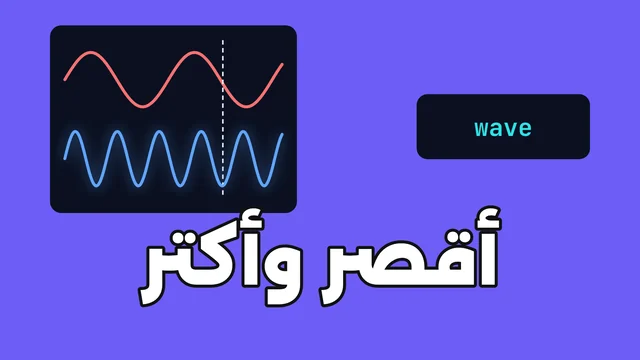
2. Energy from far away
Sunlight crosses about 150 million km of empty space. It still warms your face on a Cairo roof.
Pick the right answer
What carries the Sun's energy to you?
- A. Hot air flowing from the Sun
- B. Light, travelling as waves
- C. Sound waves from the Sun
Explanation
Light travels as waves that carry energy, even through empty space. The space between the Sun and Earth has no air, so neither hot air nor sound can carry the energy across it.
3. Wavelength
Light travels as a wave. A wave has high points, called crests.
Wavelength
The distance between two neighbouring crests of a wave.
For light, wavelengths are tiny. We measure them in nanometres (nm): 1 nm = 10⁻⁹ m.
4. Frequency
Frequency
The number of complete waves that pass a point in one second. Its unit is the hertz (Hz).
In empty space, all light travels at the same speed: 3 × 10⁸ m/s. Slide to change the wavelength. Watch the frequency.
Wavelength 700 nm
Frequency 4.3 × 10¹⁴ Hz
c = f\,
5. Your turn
Pick the right answer
Red light has a wavelength of about 700 nm. Blue light has about 450 nm. Which has the higher frequency?
- A. Red light, because its waves are longer
- B. Blue light
- C. Both the same, because all light has the same speed
Explanation
All light has the same speed in empty space, so a shorter wavelength means more waves pass each second. Blue light (about 450 nm) has the shorter wavelength, so it has the higher frequency.
Fill in the blanks
When the wavelength of light gets shorter, its frequency gets _____.
Explanation
Same speed: shorter waves mean more waves pass each second, so a higher frequency.
6. Summary
- Light travels as waves that carry energy, even through empty space.
- Wavelength: the distance between two neighbouring crests.
- Frequency: the number of waves that pass a point in one second (Hz).
- For light, a shorter wavelength means a higher frequency.
| Wavelength (nm) | Frequency (× 10¹⁴ Hz) |
|---|---|
| 400 | 7.5 |
| 500 | 6 |
| 600 | 5 |
| 700 | 4.3 |
Next: light is only one member of a bigger family of waves.
Can you explain why blue light has a higher frequency than red light?