Iron with non-metals: chlorine and sulphur
Iron(III) with chlorine, iron(II) with sulphur
1. Properties of iron
2. Same metal, two partners
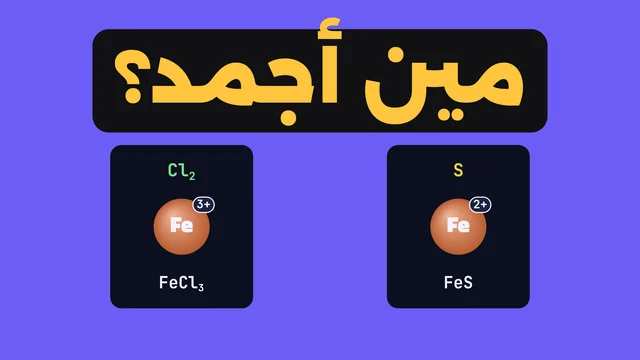
Heat iron in chlorine gas, or with sulphur powder. Both react. Do they give iron the same oxidation state?
Pick the right answer
Predict: what does iron form with chlorine?
- A. FeCl2, iron(II) chloride
- B. FeCl3, iron(III) chloride
- C. Nothing: iron reacts only with oxygen
Explanation
Heated iron reacts with chlorine to give iron(III) chloride: 2Fe + 3Cl2 → 2FeCl3. Chlorine takes iron to the +3 oxidation state.
3. With chlorine: iron(III) chloride
gathered2Fe(s) + 3Cl2(g) →[Δ]\\ 2FeCl3(s)gathered
Iron reacts with chlorine producing iron (III) chloride.
Each Cl is −1. Three Cl give −3, so iron is +3.
4. With sulphur: iron(II) sulphide
Fe(s) + S(s) →[Δ] FeS(s)
Iron reacts with sulphur producing iron (II) sulphide.
Chlorine
Strong oxidizing agent → FeCl3, iron +3
Sulphur
Weaker oxidizing agent → FeS, iron +2
In a sulphide, sulphur is −2. So iron is +2 in FeS.
5. Worked: balancing iron + chlorine
- Formulas first: Fe + Cl2 → FeCl3. Chlorine gas comes as Cl2 molecules.
- Cl: 2 on the left, 3 on the right. The lowest common multiple is 6.
- 6 Cl = 3 Cl2 on the left and 2 FeCl3 on the right.
- Now there are 2 Fe on the right, so write 2Fe on the left.
2Fe + 3Cl2 →[Δ] 2FeCl3
6. Your turn: a new metal
Balance the equation
Aluminum also reacts with chlorine on heating, giving AlCl3. Balance the equation.
Al + Cl2 →[Δ] AlCl3
Balanced equation
2Al + 3Cl2 →[Δ] 2AlCl3
Explanation
Same pattern: 6 Cl atoms = 3 Cl2 = 2 AlCl3, so 2 Al.
Need a hint?
- Which atom appears as a pair on the left and as a three on the right?
- What is the lowest common multiple of 2 and 3?
- How many AlCl3 hold that many Cl atoms? Then fix Al.
7. Iron(II) or iron(III)?
Sort into groups
Find the oxidation state of iron in each compound.
Fe2O3FeSO4FeCO3Fe2(SO4)3
Pick the right answer
A student writes Fe + S → FeSO4. What is wrong?
- A. There is no oxygen on the left, so a sulphate cannot form.
- B. Nothing: heating iron with sulphur gives a sulphate.
- C. The product should be Fe2S3, iron(III) sulphide.
- D. Iron does not react with sulphur.
Explanation
The left side holds Fe and S with no oxygen, so a sulphate cannot form. Heated iron and sulphur give iron(II) sulphide: Fe + S → FeS.
8. Summary
- Iron + chlorine → iron (III) chloride: 2Fe + 3Cl2 → 2FeCl3. Iron is +3.
- Iron + sulphur → iron (II) sulphide: Fe + S → FeS. Iron is +2.
- Sulphur is a weaker oxidizing agent than chlorine, so iron stops at +2.
- No oxygen reacts, so no sulphate forms.
Can you explain why iron is +3 in FeCl3 but +2 in FeS?
Reveal
Each Cl is −1, so three Cl give −3 and iron is +3 in FeCl3. In a sulphide, sulphur is −2, so iron is +2 in FeS. Chlorine is a strong oxidizing agent; sulphur is a weaker one.