Types of chemical reactions
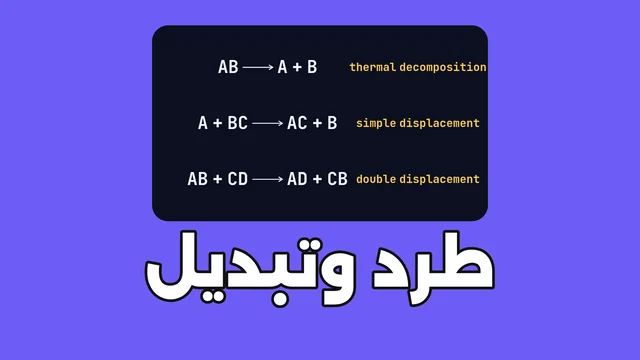
Break down, swap one, swap two
1. Types of chemical reactions: from zero
2. Green to black
Heat green copper(II) carbonate. It turns into a black powder, and a gas comes off.
Pick the right answer
Predict: what happened to the green solid?
- A. It broke down into two simpler substances
- B. It just melted
- C. It took in a gas from the air
Explanation
The green copper(II) carbonate broke down into two simpler substances: heat split it into a black solid and a gas. Melting would keep the same substance, and here a gas comes out of the solid instead of going in.
3. Thermal decomposition
Thermal decomposition
Breaking down a compound by heat into simpler substances.
CuCO3(s) →[Δ] CuO(s) + CO2(g)
Pattern: one compound in, two or more substances out. The Δ over the arrow means heat.
4. Simple displacement
Simple displacement
A more active element takes the place of a less active one in its compound.
Zn(s) + CuSO4(aq) → ZnSO4(aq) + Cu(s)
The blue colour fades, and reddish copper coats the zinc.
Metals above hydrogen also displace it from dilute acids: Mg + 2HCl → MgCl2 + H2.
5. Double displacement
Double displacement
Two compounds exchange their partners: AB + CD → AD + CB.
AgNO3(aq) + NaCl(aq) → AgCl(s) v + NaNO3(aq)
AgCl does not dissolve, so it separates as a solid. Such a solid is a precipitate, shown by ↓.
Another double displacement you know
NaOH + HCl → NaCl + H2O
6. Spot the type
Sort into groups
Sort each reaction by its type.
CaCO3 →[Δ] CaO + CO2Zn(OH)2 →[Δ] ZnO + H2OZn + H2SO4 → ZnSO4 + H2Fe + CuSO4 → FeSO4 + CuBaCl2 + Na2SO4 → BaSO4 v + 2NaClKOH + HNO3 → KNO3 + H2O
Pick the right answer
In CuSO4 + 2NaOH → Cu(OH)2 v + Na2SO4, what does ↓ after Cu(OH)2 tell you?
- A. A gas leaves the reaction
- B. An insoluble solid forms in the solution
- C. The reaction needs heat
Explanation
The down arrow ↓ after Cu(OH)2 means it is a precipitate: an insoluble solid that forms in the solution. A gas leaving is shown by ↑, and heat by Δ over the arrow.
7. Summary
- Thermal decomposition: heat breaks one compound into simpler substances.
- Simple displacement: a more active element replaces a less active one.
- Double displacement: two compounds swap partners. A precipitate (↓) or salt + water may form.
Can you explain how to tell simple from double displacement at a glance?
Reveal
| Type | What happens | Example |
|---|---|---|
| Simple displacement | A more active element takes the place of a less active one in its compound. | Zn + CuSO4 → ZnSO4 + Cu |
| Double displacement | Two compounds exchange their partners: AB + CD → AD + CB. | AgNO3 + NaCl → AgCl v + NaNO3 |
Next: roasting heats iron ores, and some of its changes are thermal decompositions.