Magnetic iron oxide Fe₃O₄
A mixed oxide: two salts prove it
1. Iron oxides
2. One oxide, two salts?
Magnetite, Fe3O4, is a black ore that sticks to a magnet. Now heat it with concentrated sulphuric acid.
Pick the right answer
Predict: how many different iron salts form?
- A. One: iron (III) sulphate only
- B. Two: iron (II) and iron (III) sulphates
- C. None: it does not react with acids
الشرح
Two salts form, iron (II) sulphate and iron (III) sulphate. Fe3O4 reacts with hot concentrated acids to give both iron (II) and iron (III) salts, which shows it is a mixed oxide.
3. A mixed oxide
Mixed oxide
Fe3O4 can be considered as mixed iron (II) and iron (III) oxides: FeO + Fe2O3.
| FeO | Fe₂O₃ | Together | |
|---|---|---|---|
| Fe atoms | 1 | 2 | 3 |
| O atoms | 1 | 3 | 4 |
It is known naturally as magnetite. It is a strong magnet.
4. Preparation
- By the action of hot air or steam on red hot iron.
- By reduction of iron (III) oxide with carbon monoxide:
gathered3Fe2O3(s) + CO(g) →[230-300\,^C]\\ 2Fe3O4(s) + CO2(g)gathered
You met route 1 in 'Effect of air and water vapour'.
5. The thermometer ladder
Reduce the same oxide, Fe2O3, at different temperatures. Move up the thermometer.
Rung 1
6. With hot concentrated acids: two salts
gatheredFe3O4 + 4H2SO4 →[conc.][Δ]\\ FeSO4 + Fe2(SO4)3 + 4H2Ogathered
It reacts with hot concentrated acids to give iron (II) and iron (III) salts, proving that it is a mixed oxide.
7. Worked: add the two parts
gatheredFeO + H2SO4 →\\ FeSO4 + H2Ogathered
gatheredFe2O3 + 3H2SO4 →\\ Fe2(SO4)3 + 3H2Ogathered
Add them. FeO + Fe2O3 = Fe3O4, and 1 + 3 = 4 H2SO4.
gatheredFe3O4 + 4H2SO4 →\\ FeSO4 + Fe2(SO4)3 + 4H2Ogathered
8. Heated in air
gathered2Fe3O4(s) + 1/2O2(g) →[Δ]\\ 3Fe2O3(s)gathered
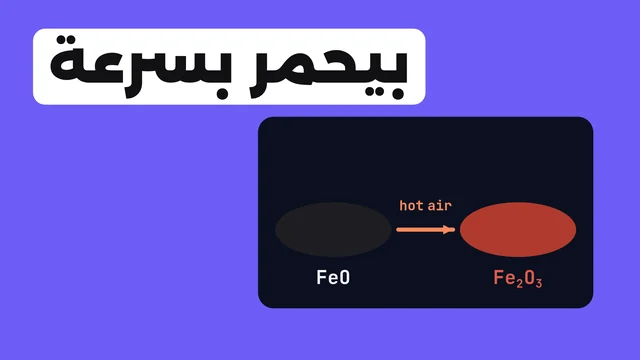
It is oxidized to iron (III) oxide when it is heated in air.
Its iron (II) part is oxidized to iron (III).
9. Your turn
Balance the equation
Now with hot concentrated hydrochloric acid. Balance it.
Fe3O4 + HCl →[conc.][Δ] FeCl2 + FeCl3 + H2O
Balanced equation
Fe3O4 + 8HCl →[conc.][Δ] FeCl2 + 2FeCl3 + 4H2O
الشرح
FeO part: 2 HCl. Fe2O3 part: 6 HCl. Total 8 HCl and 4 H2O.
Need a hint?
- Split it: what does the FeO part give with HCl?
- What does the Fe2O3 part give, and how many HCl does it use?
- Add the two parts, as in the worked example.
Pick the right answer
Which result proves that Fe3O4 is a mixed oxide?
- A. With hot concentrated acids it gives iron (II) and iron (III) salts.
- B. It is attracted by a magnet.
- C. It forms when steam passes over red hot iron.
- D. It is black.
الشرح
The proof is its reaction with hot concentrated acids: it gives iron (II) and iron (III) salts, so it holds iron in two oxidation states. Being magnetic, black, or made from red hot iron does not show that.
Pick the right answer
Magnetic iron oxide is reduced by hydrogen at 400–700 °C. What forms?
- A. FeO
- B. Fe
- C. Fe2O3
- D. FeSO4
الشرح
Hydrogen at 400–700 °C reduces magnetic iron oxide to FeO: Fe3O4 + H2 → 3FeO + H2O. Getting iron itself needs CO at a temperature higher than 700 °C.
10. Summary
- Fe3O4: black, a strong magnet, a mixed iron (II) and iron (III) oxide (magnetite).
- Made by hot air or steam on red hot iron, or Fe2O3 + CO at 230–300 °C.
- Hot conc. acids give iron (II) + iron (III) salts: proof it is mixed.
- Heated in air, it is oxidized to Fe2O3.
Can you explain why Fe₃O₄ gives two salts, but Fe₂O₃ only one?
Reveal
Fe3O4 is a mixed oxide, FeO + Fe2O3: its FeO part gives the iron (II) salt and its Fe2O3 part gives the iron (III) salt. Fe2O3 is iron (III) oxide, so it gives one salt: an iron (III) salt.