Iron and its oxides: reaction diagrams
Reagent and condition for every arrow
1. Iron oxides
2. Same reactants, different products
Pass carbon monoxide over hot Fe2O3. Change only the temperature.
Pick the right answer
Predict: can CO and Fe2O3 give different products?
- A. No: the same reactants always give the same product.
- B. Yes: the temperature decides the product.
الشرح
CO and Fe2O3 can give different products: the temperature decides. At 230–300 °C they give Fe3O4, and above 700 °C they give iron, so the condition over the arrow is part of the reaction.
3. Read each arrow: up or down?
Up adds oxygen: oxidation, by air or O2 with heat. Down removes oxygen: reduction, by H2 or CO.
Then pick the exact condition. It decides the product.
4. Worked: diagram (a)
- Fe → Fe3O4 (air or steam, red hot)
- Fe3O4 → FeO (H2, 400–700 °C)
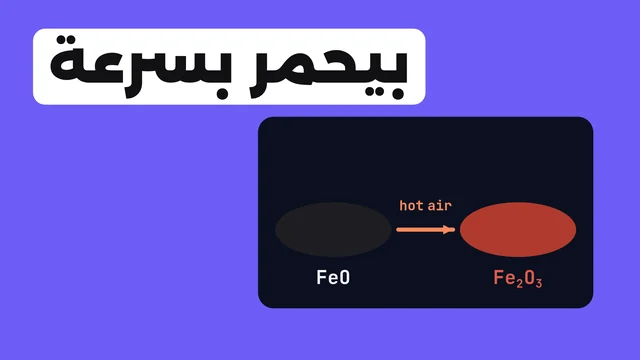
- FeO → Fe2O3 (hot air)
- Fe2O3 → Fe (CO, higher than 700 °C)
1. Fe → Fe₃O₄
3Fe + 2O2 →[Δ] Fe3O4
Up: red hot iron in dry air or oxygen.
2. Fe₃O₄ → FeO
Fe3O4 + H2 →[400-700\,^C] 3FeO + H2O
Down, middle rung: hydrogen at 400–700 °C.
3. FeO → Fe₂O₃
4FeO + O2 →[Δ] 2Fe2O3
Up: FeO is easily oxidized in hot air.
4. Fe₂O₃ → Fe
Fe2O3 + 3CO →[higher than 700\,^C] 2Fe + 3CO2
Down all the way: the blast furnace equation.
5. Faded: diagram (b)
- Fe → FeSO4 (dilute H2SO4)
- FeSO4 → Fe2O3 (heat)
- Fe2O3 → Fe3O4 (CO, 230–300 °C)
- Fe3O4 → Fe (CO, higher than 700 °C)
Fe + H2SO4 →[(dil)] FeSO4 + H2
Balance the equation
Arrow 2: heat iron (II) sulphate.
FeSO4 →[Δ] Fe2O3 + SO2 + SO3
Balanced equation
2FeSO4 →[Δ] Fe2O3 + SO2 + SO3
الشرح
2 Fe for one Fe₂O₃; the 2 S leave as SO₂ and SO₃.
Balance the equation
Arrow 3: the lowest rung.
Fe2O3 + CO →[230-300\,^C] Fe3O4 + CO2
Balanced equation
3Fe2O3 + CO →[230-300\,^C] 2Fe3O4 + CO2
الشرح
6 Fe make 2 Fe₃O₄. 9 O − 8 O leaves 1 O for one CO.
6. Which rung?
Sort into groups
Fe2O3 is reduced under each condition. Sort by the product.
CO at 230–300 °CH2 at 400–700 °CCO higher than 700 °CCO at 400–700 °C
7. Your turn: the last arrows
Balance the equation
Diagram (b), Fe3O4 → Fe2O3: heat in air. Use whole numbers.
Fe3O4 + O2 →[Δ] Fe2O3
Balanced equation
4Fe3O4 + O2 →[Δ] 6Fe2O3
الشرح
The book writes 2Fe3O4 + 1/2O2 → 3Fe2O3. Doubled: 4, 1, 6.
Pick the right answer
Which reagent and condition turn Fe3O4 into iron?
- A. CO, higher than 700 °C
- B. CO, 230–300 °C
- C. Hot air
- D. Dilute H2SO4
الشرح
CO at a temperature higher than 700 °C turns Fe3O4 into iron, because it removes all the oxygen. CO at 230–300 °C stops at Fe3O4, hot air adds oxygen, and a dilute acid gives a salt, not the metal.
Pick the right answer
Which condition turns FeO into Fe2O3?
- A. Heating in hot air
- B. Heating in absence of air
- C. CO at 230–300 °C
- D. Dilute H2SO4
الشرح
Heating in hot air turns FeO into Fe2O3: FeO is easily oxidized in hot air, 4FeO + O2 → 2Fe2O3. This step adds oxygen, so it needs air, not a reducing agent like CO.
8. Summary
- Up (more oxygen): air or O2 with heat.
- Down (less oxygen): H2 or CO; the temperature decides how far.
- Fe2O3 + CO: 230–300 °C → Fe3O4; 400–700 °C → FeO; higher than 700 °C → Fe.
- Fe → FeSO4: dilute H2SO4. FeSO4 → Fe2O3: heat.
Can you explain why CO gives Fe₃O₄ in one case and iron in another?
Reveal
The temperature decides how much oxygen CO removes. At 230–300 °C, CO turns Fe2O3 into Fe3O4; higher than 700 °C, it removes all the oxygen and gives iron.