Acids, bases and salts
What makes copper (II) sulphate a salt?
1. Acids, bases and salts: from zero
2. Not all salts are for food
Table salt, NaCl, is a salt. So is copper (II) sulphate, CuSO₄, and nobody eats it.
Pick the right answer
Predict: what do NaCl and CuSO₄ have in common?
- A. Each has a metal joined to the rest of an acid
- B. Both taste salty
- C. Both dissolve in water
الشرح
In both, a metal has taken the place of the hydrogen of an acid: Na with the Cl of hydrochloric acid, Cu with the SO₄ of sulphuric acid. That is what makes them salts, not their taste or dissolving.
3. Acids
Acid
A substance that gives positive hydrogen ions (H⁺) when dissolved in water.
An ion is an atom, or a group of atoms, with an electric charge. You'll study ions later in Chapter 1.
| Acid | Formula | Its salts are called |
|---|---|---|
| hydrochloric acid | HCl | chlorides |
| sulphuric acid | H₂SO₄ | sulphates |
| nitric acid | HNO₃ | nitrates |
Acids taste sour and turn litmus red. Never taste them in the lab!
4. Bases
Base
A substance that reacts with an acid to give a salt and water.
Many metal oxides and metal hydroxides are bases. Examples: copper (II) oxide, CuO, and magnesium hydroxide, Mg(OH)₂.
| Base | Formula | Type |
|---|---|---|
| copper (II) oxide | CuO | metal oxide |
| magnesium hydroxide | Mg(OH)₂ | metal hydroxide |
You'll meet metal oxides as bases again in the next lesson.
5. Alkalis
Alkali
A base that dissolves in water, giving hydroxide ions (OH⁻).
Examples: sodium hydroxide, NaOH, and ammonium hydroxide, NH₄OH. Alkalis turn litmus blue.
True or false?
NaOH is an acid, because its formula contains H.
الشرح
NaOH is an alkali, not an acid: its H is part of the OH group, and in water it gives hydroxide ions (OH⁻).
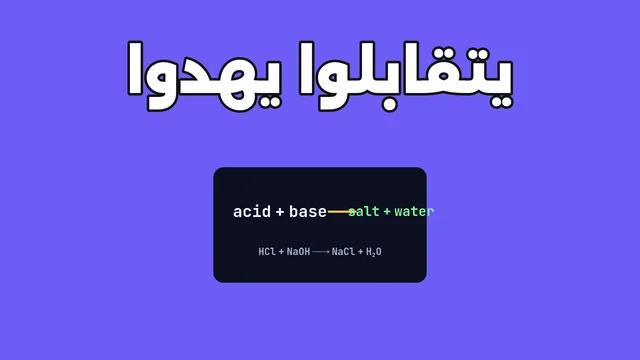
6. Acid + base → salt + water
gatheredNaOH + HCl →\\ NaCl + H2Ogathered
Salt
A compound formed when the hydrogen of an acid is replaced by a metal (or ammonium).
Naming rule: the metal's name from the base + the ending from the acid. Copper (II) oxide + sulphuric acid → copper (II) sulphate + water.
7. Name the parent acid
Sort into groups
Which acid does each salt come from?
ZnCl₂, zinc chlorideMnSO₄, manganese (II) sulphateKNO₃, potassium nitrateNa₂SO₄, sodium sulphateNH₄Cl, ammonium chloride
Pick the right answer
Which pair reacts to give zinc nitrate and water?
- A. ZnO and HNO₃
- B. ZnO and H₂SO₄
- C. NaOH and HNO₃
- D. ZnO and HCl
الشرح
Zinc nitrate takes its metal, zinc, from the base ZnO, and its ending, nitrate, from nitric acid, HNO₃. A base and an acid give a salt and water.
8. Summary
- Acids give hydrogen ions, H⁺, in water: HCl, H₂SO₄, HNO₃.
- Bases react with acids to give a salt and water. Many metal oxides and hydroxides are bases.
- Alkalis are bases that dissolve in water, giving OH⁻: NaOH, NH₄OH.
- Chlorides, sulphates and nitrates come from HCl, H₂SO₄ and HNO₃.
Back to the hook: NaCl and CuSO₄ are both salts. In each, a metal replaced the hydrogen of an acid.
Can you explain why CuSO₄ is a salt of sulphuric acid?
Reveal
In CuSO₄, copper has replaced the hydrogen of sulphuric acid, H₂SO₄. The SO₄ group comes from the acid, so the salt is a sulphate.