Definition of the transition element
Two places to look for an incomplete d sublevel
1. Electronic configurations and oxidation states
2. Is scandium in or out?
Scandium is the first element of the series. But Sc³⁺, its only ion, has no d electrons at all.
Pick the right answer
Predict: is scandium a transition element?
- A. Yes
- B. No: Sc³⁺ has no d electrons
- C. Only as an atom, not in its compounds
Explanation
Scandium is a transition element. The book's definition also checks the atom: the Sc atom is 3d¹, an incomplete d sublevel, even though Sc³⁺ has no d electrons.
3. The book's definition
Transition element
The element in which the orbitals of d or f contain electrons but they are not complete, in its atomic state or in one of its oxidation states.
- Atom: is the d sublevel incomplete (d¹ to d⁹)? → Transition element (yes)
- Atom: is the d sublevel incomplete (d¹ to d⁹)? → Is d incomplete in one of its oxidation states? (no)
- Is d incomplete in one of its oxidation states? → Transition element (yes)
- Is d incomplete in one of its oxidation states? → Not a transition element (no)
Incomplete means 1 to 9 d electrons. Being in the d-block is not enough: a full d¹⁰ fails. The f case is for inner transition elements.
4. Complete or not?
Slide the number of d electrons. When is the d sublevel incomplete?
d electrons 0
d
5. Worked: scandium; your turn: manganese
Step 1: Test the atom
₂₁Sc:\ [Ar]\ 4s²\ 3d¹
3d holds one electron: incomplete. Scandium passes on the atom alone.
Step 2: Does Sc³⁺ change the verdict?
No. Sc³⁺ is [Ar], with 3d⁰. But the definition says atom OR one of its oxidation states. One pass is enough.
Your turn: manganese
Fill in the blanks
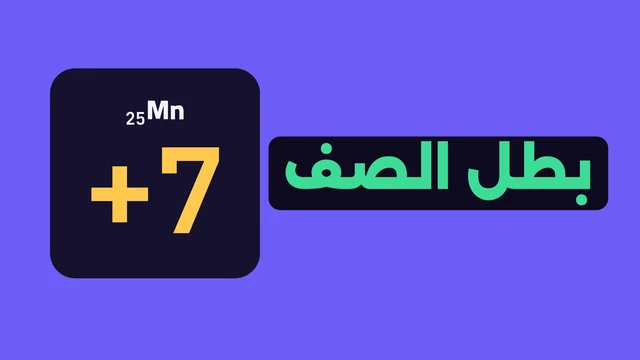
₂₅Mn: [Ar] 4s² 3d_____ . In KMnO4 (+7), the Mn has 3d_____ .
Explanation
Mn atom: 3d⁵, incomplete, so Mn is a transition element. Mn(+7) is 3d⁰, but one pass is enough.
Need a hint?
- [Ar] holds 18 electrons; 4s holds 2.
- For +7, start from 7 electrons in 4s and 3d.
- 4s leaves first, then 3d.
6. Sort the elements
Sort into groups
Sort each element with the book's definition.
₂₂Ti: [Ar] 4s²\ 3d²₂₀Ca: [Ar] 4s²; only state +2: [Ar]₃₁Ga: [Ar] 4s²\ 3d¹⁰\ 4p¹; state +3: [Ar] 3d¹⁰₂₇Co: [Ar] 4s²\ 3d⁷₁₉K: [Ar] 4s¹; only state +1: [Ar]₃₀Zn: [Ar] 4s²\ 3d¹⁰; only state +2: [Ar] 3d¹⁰
7. Titanium in TiO₂
Pick the right answer
In TiO2, titanium is +4, so its d sublevel is empty (3d⁰). A student says titanium is therefore not a transition element. What is wrong?
- A. The definition is met by the atom or one of its states, and the Ti atom is 3d²
- B. Nothing: an element with a 3d⁰ state is not transition
- C. Ti in +4 still keeps its 4s electrons
Explanation
The definition is met when the d sublevel is incomplete in the atom or in any one of its oxidation states. The Ti atom is 3d², so titanium is a transition element even though Ti(+4) is 3d⁰.
True or false?
To decide if an element is a transition element, we check only its neutral atom.
Explanation
'… in their atomic state or in one of their oxidation states' (book p.10).
8. Summary
- A transition element has d (or f) orbitals that contain electrons but are not complete.
- Test the atom first; if it fails, test its oxidation states. One pass is enough.
- Scandium is a transition element: its atom is 3d¹, though Sc³⁺ is 3d⁰.
Next: copper's atom is 3d¹⁰ like zinc's, yet copper is a transition element. Why?
Can you explain why scandium counts, though Sc³⁺ has no d electrons?
Reveal
Scandium's atom is 3d¹: its d orbitals contain electrons but are not complete, so the atom passes the test. One pass is enough, though Sc³⁺ is 3d⁰.