Reading equations: states and conditions
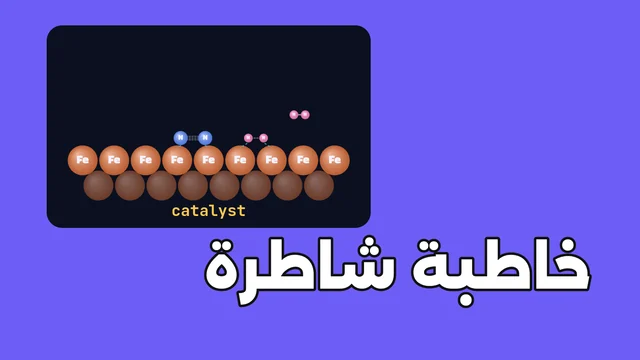
What the brackets and the arrow tell you
1. Magnetic properties and catalytic activity
2. What does 500 °C mean?
Later in Chapter 1 you will meet:
gathered3Fe(s) + 4H2O(v) →[500\,^C]\\ Fe3O4(s) + 4H2(g)gathered
Pick the right answer
Predict: what does 500 °C over the arrow tell you?
- A. The reaction needs a temperature of 500 °C
- B. The reaction gives out 500 °C of heat
- C. 500 °C is one of the products
Explanation
500 °C over the arrow is a condition: the reaction needs this temperature to take place. Products are written after the arrow as formulas, and a temperature is not a substance.
3. State symbols
State symbol
A letter in brackets after a formula that shows the physical state of the substance.
| Symbol | Meaning |
|---|---|
| (s) | solid |
| (l) | liquid |
| (g) | gas |
| (v) | vapour (water as steam) |
| (aq) | aqueous: dissolved in water |
Zn(s) + 2HCl(aq) → ZnCl2(aq) + H2(g)
Read it: solid zinc and hydrochloric acid solution give zinc chloride solution and hydrogen gas.
4. Over the arrow
CaCO3(s) →[Δ] CaO(s) + CO2(g)
2KClO3(s) →[MnO2][Δ] 2KCl(s) + 3O2(g)
Over and under the arrow go the conditions: Δ (heating), a temperature, a pressure or a catalyst.
5. Read new equations
gatheredC(s) + H2O(v) →[1000\,^C]\\ CO(g) + H2(g)gathered
Sort into groups
Sort each part of this equation:
C(s)H₂O(v)1000 °CCO(g)H₂(g)
gatheredCaCO3(s) + 2HCl(aq) →\\ CaCl2(aq) + H2O(l) + CO2(g)gathered
Fill in the blanks
In this reaction, the CO2 comes off as a _____, and the CaCl2 is _____ in water.
Explanation
(g) = gas; (aq) = aqueous, dissolved in water.
6. Summary
- (s) solid, (l) liquid, (g) gas, (v) vapour, (aq) dissolved in water.
- Over the arrow: conditions: Δ (heat), temperature, pressure, catalyst.
- What is over the arrow is neither a reactant nor a product.
Can you explain why a catalyst is written over the arrow and not with the reactants?
Reveal
2KClO3(s) →[MnO2][Δ] 2KCl(s) + 3O2(g)
A catalyst such as MnO2 is a condition: it is not used up, so it is on neither side. It is written over the arrow.