Writing and balancing chemical equations
Count the atoms on both sides
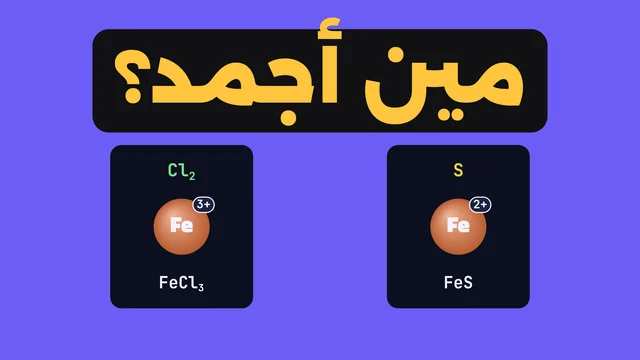
1. Properties of iron
2. Do the atoms add up?
In a reaction, no atom is created or destroyed. Nitrogen and hydrogen react to give ammonia.
N2 + H2 → NH3
Pick the right answer
Predict: count the atoms. Is this equation balanced?
- A. Yes: N and H appear on both sides
- B. No: the atom counts differ
- C. We can't tell without the conditions
Explanation
The equation is not balanced: the left side has 2 N atoms and 2 H atoms, while the right side has 1 N atom and 3 H atoms. Atoms are not created or destroyed in a reaction, so coefficients are needed to make the counts equal.
3. Coefficients, not subscripts
Coefficient
The number written before a formula in an equation. It multiplies the whole formula.
| In 2Cl₂ | Meaning |
|---|---|
| 2 (coefficient) | two molecules |
| 2 (subscript) | two Cl atoms in each molecule |
| total | 2 × 2 = 4 Cl atoms |
Conditions, like a catalyst or temperature, go over the arrow: →[Δ].
4. Worked: water
H2 + O2 → H2O
- Count: H 2 and 2; O 2 on the left, 1 on the right. O is not balanced.
- Put 2 before H₂O: O is now 2 and 2. But H is now 2 on the left and 4 on the right.
- Put 2 before H₂: H is 4 and 4.
- Check every atom: H 4 = 4, O 2 = 2. Balanced: 2H2 + O2 → 2H2O.
Fixing one atom can unbalance another. So always recount at the end.
5. Balance it yourself
Set the coefficients for N2 + H2 → NH3. Make both sides match.
Coefficient of N2 1
Coefficient of H2 1
Coefficient of NH3 1
N left 2
N right 1
H left 2
H right 3
6. New equations
Balance the equation
Balance the equation.
Al + O2 → Al2O3
Balanced equation
4Al + 3O2 → 2Al2O3
Explanation
Al 4 = 4 and O 6 = 6: 4Al + 3O2 → 2Al2O3.
Need a hint?
- Start with O: 2 on the left, 3 on the right. Which number do 2 and 3 both go into?
- Make O equal 6 on both sides. Then count Al again.
Pick the right answer
To balance Mg + O2 → MgO, a student writes Mg + O2 → MgO2. What is wrong?
- A. The subscript was changed, so the product is no longer magnesium oxide
- B. Nothing: the atoms are now equal on both sides
- C. The arrow should point the other way
- D. A coefficient was put before O₂
Explanation
Changing the subscript turned the product into MgO₂, which is a different substance from magnesium oxide. Only coefficients may change when balancing: 2Mg + O2 → 2MgO.
7. Summary
- Reactants → products; conditions are written over the arrow.
- Balance by changing coefficients only, never subscripts.
- Check: each kind of atom has the same count on both sides.
Back to the hook: N2 + 3H2 → 2NH3 has 2 N and 6 H on each side. No atom is lost.
Can you explain why changing H₂O to H₂O₂ is not a way to balance an equation?
Reveal
A subscript is part of the formula: changing H₂O to H₂O₂ turns water into a different substance. Only coefficients may change: 2H2 + O2 → 2H2O.