Intermetallic alloys
The elements combine chemically into a compound
1. Alloys and their types
2. Same elements, same type?
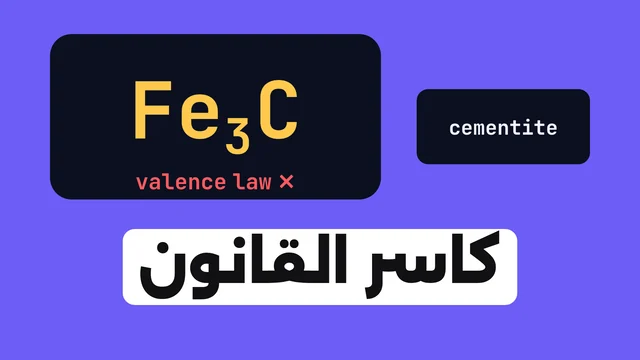
Steel and cementite, Fe3C, are both made of iron and carbon. Steel is an interstitial alloy.
Pick the right answer
Predict: is cementite also an interstitial alloy?
- A. Yes: same elements, same type
- B. No: in cementite, Fe and C combine chemically
- C. No: it is substitutional
Explanation
Cementite is not an interstitial alloy: in Fe3C, iron and carbon combine chemically into a compound with a fixed formula, so it is an intermetallic alloy. Steel, made of the same elements, is the interstitial one.
3. A compound, not a mixture
Intermetallic alloy
An alloy in which the elements combine with each other chemically to form a chemical compound.
| Steel | Cementite | |
|---|---|---|
| Elements | Fe + C | Fe + C |
| Formula | No fixed formula: the amount of carbon can vary | Fe3C, fixed |
| Type | Interstitial | Intermetallic: chemically combined |
A fixed formula means a fixed ratio of atoms. In steel, the amount of carbon can vary.
4. Worked: test Fe₃C with valency
The book adds: its chemical formula disobeys the valence law. Test Fe3C with the swap method.
| Iron valency | Carbon valency | Swap, then simplify | Gives Fe₃C? |
|---|---|---|---|
| 2 | 4 | Fe4C2 → Fe2C | No |
| 3 | 4 | Fe4C3 | No |
No valency of iron gives Fe3C. The formula disobeys the valence law.
Note: the swap pairs a metal with a non-metal. Two metals, as in Au2Pb, cannot be paired by valency at all.
5. Your turn: metal X
Metal X has valency 2 only. With carbon (valency 4), it forms X3C in an alloy.
Fill in the blanks
By the swap method, X (2) and C (4) give X_____C after simplifying.
Explanation
Swapping the valencies of X (2) and C (4) gives X4C2, which simplifies to X2C.
Pick the right answer
So what does X3C tell you?
- A. It disobeys the valence law, so X and C form an intermetallic compound
- B. It obeys the valence law
- C. It is a physical mixture of X and C
Explanation
Valency predicts X2C, but the real formula is X3C, so it disobeys the valence law. A real formula that valency cannot explain is the sign that X and C form an intermetallic compound.
6. The book's examples
In these alloys, the metals are not in the same group of the periodic table.
| Alloy | Elements | Groups |
|---|---|---|
| Duralumin | Al-Ni and Al-Cu | IIIA with VIII or IB |
| Lead-gold | Au2Pb | IB with IVA |
| Cementite | Fe3C | VIII with IVA |
Careful: the group alone does not decide the type. The test is a chemical compound with a fixed formula.
7. Three types, one sort
Sort all the alloys you have met. Ask: spaces, places, or a compound?
Sort into groups
Which type is each alloy?
Steel (Fe + C)Cementite, Fe3CFerrochrome (Fe-Cr)Copper-gold alloyAu2PbDuralumin (Al-Cu)
8. Check yourself
Pick the right answer
Metals P and Q, from different groups, form an alloy with the fixed formula P3Q. Valency cannot explain this formula. What type is it?
- A. Intermetallic
- B. Substitutional
- C. Interstitial
- D. Not an alloy: a physical mixture
Explanation
It is an intermetallic alloy: P and Q are metals from different groups that combine chemically into a compound with a fixed formula that disobeys the valence law.
True or false?
In duralumin, aluminum and copper are only physically mixed.
Explanation
In duralumin, aluminum and copper combine chemically: the book puts duralumin among the intermetallic alloys.
9. Summary
- Intermetallic alloy: the elements combine chemically to form a chemical compound.
- Its formula disobeys the valence law: no valency of iron gives Fe3C.
- The metals are not in the same group of the periodic table.
- Book examples: duralumin (Al-Ni, Al-Cu), Au2Pb, cementite Fe3C.
Back to the hook: can you explain why steel and cementite are different types, though both are Fe + C?
Reveal
In steel, the amount of carbon can vary: it is an interstitial alloy. In cementite, Fe and C combine chemically to form a compound with the fixed formula Fe3C: an intermetallic alloy.