Catalytic activity of transition elements
Why transition elements are ideal catalysts
1. Magnetic properties and catalytic activity
2. The fizzing powder, again
A pinch of MnO2 makes H2O2 fizz fast, and the MnO2 is still there at the end. How?
Pick the right answer
Predict: what does the MnO2 change?
- A. It lowers the activation energy, the hump
- B. It makes the reaction release more energy
- C. It reacts with H2O2 and is used up
الشرح
Fig 1-3: with MnO2 the hump (the activation energy) is lower, so H2O2 decomposes faster. The reactants and products are the same, so the net energy released does not change, and the MnO2 is still there at the end.
3. Fig 1-3, step by step
2H2O2 →[MnO2] 2H2O + O2
1 = no catalyst, 2 = with MnO2 1
True or false?
Activation energy is the energy given out by the reaction.
الشرح
In fig 1-3, the activation energy is measured from the reactants up to the top of the hump; the net energy released is measured from the reactants down to the products.
4. Lower hump, same drop
Look at the two ends of the curves in fig 1-3 below. The catalyst does not move them.
True or false?
A catalyst gives more product or more energy.
الشرح
A catalyst lowers the activation energy. The reactants, the products and the net energy released stay the same, so the same products simply form faster.
So a catalyst changes only how fast the products form.
5. Why transition elements?
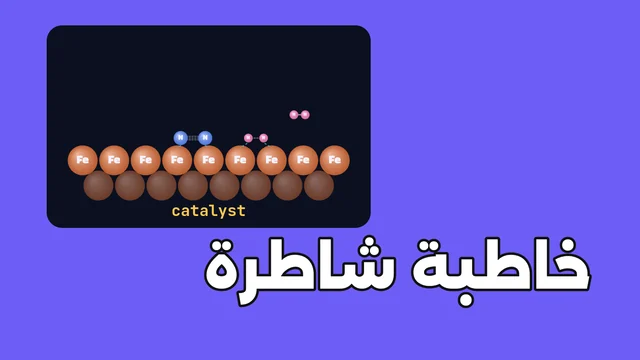
Book: transition elements are considered ideal catalysts. The reason is in their 4s and 3d electrons.
- 4s and 3d electrons form bonds between surface atoms and reacting molecules → Concentration of the molecules on the surface increases
- Concentration of the molecules on the surface increases → Bonds in the reactant molecules weaken
- Bonds in the reactant molecules weaken → Activation energy decreases
- Activation energy decreases → Speed of reaction increases
6. On the surface
stage 1
Molecules arrive. The metal's 4s and 3d electrons form bonds with them.
7. Rebuild the chain
Put in order
Put the book's reason in order, from the electrons to the speed.
- 4s and 3d electrons form bonds between surface atoms and reacting molecules
- The concentration of reacting molecules on the surface increases
- The bonds in the reactant molecules weaken
- The activation energy decreases
- The speed of reaction increases
8. New reaction, same rules
A new reaction (made-up values): activation energy 180 kJ, net energy released 60 kJ. A catalyst lowers the activation energy to 100 kJ.
Pick the right answer
With the catalyst, how much net energy is released?
- A. 60 kJ
- B. 140 kJ: the 80 kJ saved is given out too
- C. 100 kJ, the same as the new activation energy
الشرح
Net energy released = the drop from the reactants to the products. The catalyst lowers the activation energy (180 kJ → 100 kJ) but does not move the reactant and product levels, so the net energy released stays 60 kJ.
True or false?
Transition elements are good catalysts simply because they are metals.
الشرح
Book p.15: the catalytic activity of the first transition series comes from their 4s and 3d electrons. They form bonds with the reacting molecules on the surface, which raises the molecules' concentration there, weakens their bonds and lowers the activation energy.
True or false?
After the reaction, the catalyst has less mass, because it formed bonds with the molecules.
الشرح
A catalyst is not used up. It bonds to the reacting molecules for a short time, the products leave the surface, and the same mass of catalyst remains at the end.
9. Summary
- A catalyst lowers the activation energy, so the reaction is faster (fig 1-3).
- Same products, same net energy released; the catalyst is not used up.
- Transition elements are ideal catalysts: their 4s and 3d electrons form bonds with reacting molecules on the surface.
| Without catalyst | With MnO2 | |
|---|---|---|
| Activation energy | higher | lower |
| Products | 2H2O + O2 | 2H2O + O2 |
| Net energy released | same | same |
| Speed of reaction | slower | faster |
Back to the hook: can you explain how MnO2 speeds up H2O2 and is still there at the end?