Ions (cations and anions)
What the small charge on Fe²⁺ means
1. Ions (cations and anions): from zero
2. What does the 2+ mean?
Chapter 1 writes iron as Fe²⁺ and Fe³⁺. What does the small charge mean?
Pick the right answer
Predict: an iron atom has 26 protons and 26 electrons. How many electrons does Fe²⁺ have?
- A. 24
- B. 28
- C. 26
الشرح
Fe²⁺ has 24 electrons: the atom loses 2 electrons while its 26 protons stay the same, so 26 positive charges against 24 negative ones leave a charge of 2+.
3. Ion
Remember: a neutral atom has equal numbers of protons (+) and electrons (−).
Ion
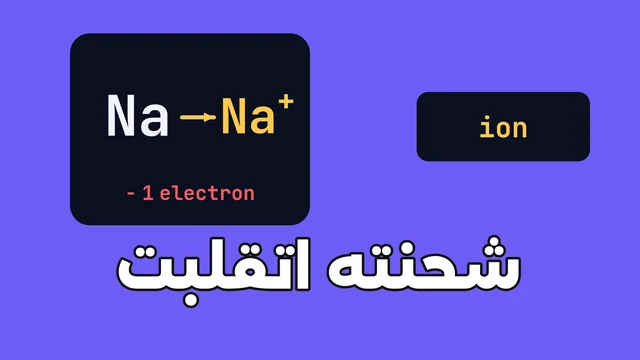
An atom, or a group of atoms, that carries an electric charge because it lost or gained electrons.
- Na atom: 11 protons, 11 electrons → Na⁺ ion: 11 protons, 10 electrons (loses 1 electron)
When an ion forms, only electrons move. The protons stay the same, so it is still the same element.
4. Make iron ions
Take electrons away from an iron atom (Z = 26). Watch the charge.
electrons lost 0
protons 26
electrons 26
positive charge 0
Cation
A positive ion. Its charge equals the number of electrons the atom lost.
5. Anion
In ionic compounds, non-metal atoms such as Cl and O gain electrons.
Anion
A negative ion. Its charge equals the number of electrons the atom gained.
Cl gains 1 electron
Cl-: 17 protons, 18 electrons
O gains 2 electrons
O²⁻: 8 protons, 10 electrons
- Cl atom: 17 protons, 17 electrons → Cl⁻ ion: 17 protons, 18 electrons (gains 1 electron)
- O atom: 8 protons, 8 electrons → O²⁻ ion: 8 protons, 10 electrons (gains 2 electrons)
In FeCl3, the cation Fe³⁺ meets three anions Cl-.
6. Count the electrons
Fill in the blanks
₂₉Cu²⁺ has _____ electrons.
الشرح
Cu has 29 electrons; losing 2 leaves 27. Protons stay 29.
Pick the right answer
A particle has 25 protons and 23 electrons. What is it? (Mn: Z = 25, V: Z = 23)
- A. Mn²⁺
- B. V²⁺
- C. Mn²⁻
- D. a neutral Mn atom
الشرح
Protons (25) fix the element: Mn. Charge = 25 − 23 = +2.
7. Summary
- An ion forms when an atom loses or gains electrons. Its protons do not change.
- Cation: positive, electrons lost (e.g. Fe³⁺). Anion: negative, electrons gained (e.g. Cl-).
- Electrons in a cation = Z − charge: Fe²⁺ has 26 − 2 = 24.
Next: which electrons does iron lose first, 4s or 3d? That is the next lesson.
Can you explain why Fe and Fe³⁺ are the same element, though their electrons differ?
Reveal
Fe and Fe³⁺ both have 26 protons. When an ion forms, only electrons move; the protons stay the same, so it is still the same element.