Bond breaking and bond forming
Where the energy of a reaction comes from
1. Bond breaking and bond forming: from zero
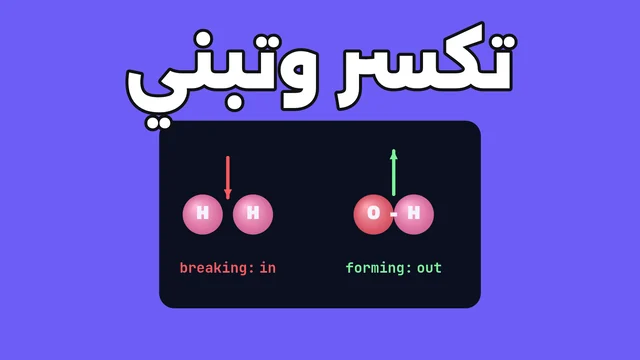
2. Where does the heat come from?
Hydrogen burns in chlorine and gives out heat. Yet the H2 and Cl2 molecules must first come apart.
Pick the right answer
Predict: where does the heat come from?
- A. From breaking the bonds in H2 and Cl2
- B. From forming the new H–Cl bonds, which gives out more energy than breaking took
- C. The atoms are destroyed and turn into heat
الشرح
Breaking the bonds in H2 and Cl2 takes energy in; forming the new H–Cl bonds gives energy out. Forming gives out more than breaking took, so heat is given out overall.
3. Break, then form
- H₂ + Cl₂ → H, H, Cl, Cl (separate atoms) (break bonds: energy absorbed)
- H, H, Cl, Cl (separate atoms) → 2HCl (form bonds: energy released)
A reaction breaks the bonds of the reactants and forms new bonds in the products.
Breaking a bond absorbs energy. Forming a bond releases energy.
4. The energy balance
Made-up numbers: breaking the reactants' bonds absorbs 600 kJ (kilojoules, a unit of energy). Change the energy released by the new bonds.
energy released by forming bonds 750 kJ
absorbed by breaking 600 kJ
energy change (ΔH) = absorbed − released -150 kJ
Chemists write the energy change, ΔH, as absorbed − released. A minus sign means energy is given out.
5. Your turn
True or false?
Breaking the bonds in the reactants releases energy.
الشرح
Breaking bonds absorbs energy, because the atoms hold each other and must be pulled apart. Energy is released when the new bonds form.
Pick the right answer
In a reaction, breaking bonds absorbs 500 kJ and forming bonds releases 300 kJ. What is the result?
- A. It releases 800 kJ
- B. It releases 200 kJ
- C. It takes in 200 kJ
الشرح
ΔH = absorbed − released = 500 − 300 = +200 kJ. Positive, so the reaction takes in 200 kJ.
6. Summary
- A reaction = breaking the reactants' bonds + forming the products' bonds.
- Breaking bonds absorbs energy; forming bonds releases energy.
- The balance is the energy change, ΔH = absorbed − released: negative = given out, positive = taken in.
Back to the hook: can you explain why hydrogen burning in chlorine gives out heat?
Reveal
Breaking the bonds in H2 and Cl2 absorbs energy. Forming the new H–Cl bonds releases more energy than breaking took, so ΔH is negative and the reaction gives out heat.