Haber-Bosch method for ammonia
Making ammonia from nitrogen and hydrogen
1. Magnetic properties and catalytic activity
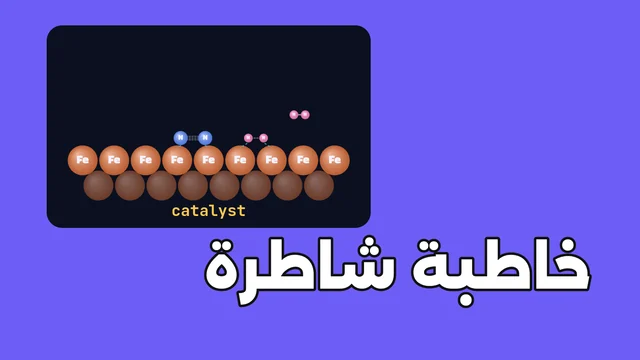
2. Ammonia from air
Air is mostly nitrogen. Factories turn it into ammonia, NH3, by the Haber-Bosch method.
Pick the right answer
Predict: which gas must react with nitrogen to give NH3?
- A. Hydrogen
- B. Oxygen
- C. No other gas: nitrogen alone becomes ammonia
الشرح
NH3 is made of nitrogen and hydrogen, so nitrogen must react with hydrogen: N2 + 3H2 → 2NH3.
3. The book's equation
gatheredN2(g) + 3H2(g) →[500\,^C / 200\,atm,\ Fe]\\ 2NH3(g)gathered
Read it: nitrogen gas and hydrogen gas give ammonia gas. One N2 reacts with three H2 to give two NH3.
Over the arrow: 500 °C, a pressure of 200 atm, and iron, Fe, the catalyst. 200 atm (atmospheres) is 200 times normal air pressure.
4. Why iron is needed
The bond in N2 is very strong. Breaking it needs a high activation energy, so the reaction is very slow.
Iron, a transition element, lowers the activation energy. So ammonia forms fast enough for a factory.
| Without iron | With iron (catalyst) | |
|---|---|---|
| Activation energy | high | lowered |
| Rate of forming ammonia | very slow | fast enough for a factory |
5. Use the equation
Pick the right answer
In the Haber-Bosch method, 6 molecules of H2 react completely with enough N2. How many molecules of NH3 form?
- A. 4
- B. 6
- C. 2
- D. 12
الشرح
In N2 + 3H2 → 2NH3, three H2 give two NH3. Six H2 are two sets of three, so they give 4 NH3.
Pick the right answer
Which statement about the iron in the Haber-Bosch method is correct?
- A. It lowers the activation energy and is not used up
- B. It reacts with nitrogen to form ammonia
- C. It increases the amount of ammonia formed
الشرح
Iron is the catalyst, written over the arrow: it lowers the activation energy, so the reaction goes faster, and it is not used up. It is not part of NH3 and gives no extra product.
6. Summary
- Ammonia is made industrially from nitrogen and hydrogen by the Haber-Bosch method.
- gatheredN2(g) + 3H2(g) →[500\,^C / 200\,atm,\ Fe]\\ 2NH3(g)gathered
- Iron is the catalyst: it lowers the activation energy of this slow reaction.
Can you explain why iron is written over the arrow and not as a reactant?
Reveal
Iron is the catalyst, not a reactant: it lowers the activation energy and speeds up the reaction, but it is not used up and gives no extra ammonia. That is why it sits over the arrow.