Electron spin and the Pauli principle
Why paired electrons cancel and unpaired ones don't
1. Electron spin and the Pauli principle: from zero
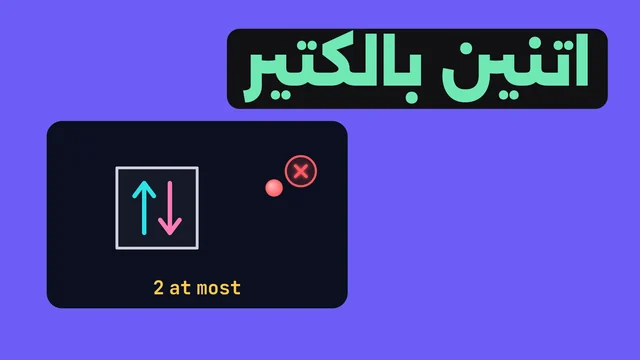
2. Two tiny magnets in one box
Every electron behaves like a tiny magnet. What happens when two of them share one orbital?
Pick the right answer
Predict: two electrons share one orbital. What happens to their magnetic effects?
- A. They add up, so the orbital is twice as magnetic
- B. They cancel, because the two electrons spin in opposite directions
- C. One of the electrons stops spinning
الشرح
The two electrons in one orbital spin in opposite directions, so their magnetic effects cancel. This is what the Pauli exclusion principle requires.
3. Spin makes a tiny magnet
Remember: an orbital is the region around the nucleus where an electron is most likely found.
spin
Each electron spins around its own axis. This spinning forms a magnetic field, so the electron behaves like a tiny magnet.
↑
one orbitalAn electron can spin in one of two directions. We draw them as and .
4. The Pauli exclusion principle
Pauli exclusion principle
One orbital holds two electrons at most, and they must have opposite spins ().
↑↓
one orbitalWith opposite spins, the two tiny magnets point opposite ways. So their magnetic effects cancel.
5. Paired or unpaired?
Add electrons to one orbital and watch what happens.
Electrons added 1
↑
one orbitalunpaired electron
An electron alone in its orbital (). Its magnetic effect is not cancelled.
6. Check yourself
Pick the right answer
Which orbital breaks the Pauli exclusion principle?
- A. []
- B. []
- C. []
الشرح
[] breaks the Pauli exclusion principle: two electrons in one orbital must have opposite spins. [] follows it, and one unpaired electron, [], breaks no rule.
Fill in the blanks
The d sublevel has 5 orbitals. So it holds at most _____ electrons.
الشرح
5 orbitals × 2 electrons each = 10 electrons.
True or false?
In the orbital [], the magnetic effects of the two electrons add up.
الشرح
In [] the two electrons have opposite spins, so their magnetic effects cancel. Adding up would need the same spin, which the Pauli exclusion principle does not allow in one orbital.
7. Summary
- A spinning electron behaves like a tiny magnet. and are its two spin directions.
- Pauli: one orbital holds two electrons at most, with opposite spins ().
- A pair's magnetic effects cancel. An unpaired electron keeps its effect.
Can you explain why two electrons in the same orbital have no overall magnetic effect?
Reveal
The two electrons have opposite spins (). Their two tiny magnets point opposite ways, so their magnetic effects cancel.